
The best things to do in Chhatrapati Sambhajinagar, formerly Aurangabad, are the two UNESCO World Heritage cave sites, Ellora with its astonishing rock-cut Kailasa temple about 30 kilometres away, and the painted Buddhist caves of Ajanta about 100 kilometres away, along with the marble Bibi Ka Maqbara, the hill fort of Daulatabad and the Grishneshwar Jyotirlinga temple. It is one of India's great heritage circuits.
Chhatrapati Sambhajinagar, the city most travellers still know as Aurangabad, is the gateway to two of the finest ancient monuments in the world, the rock-cut caves of Ellora and Ajanta. Around them sits a city full of its own history, a Mughal-era marble tomb often called the Taj of the Deccan, a dramatic medieval fort, ancient Buddhist caves and a distinctive Deccan cuisine. We run a hotel here, so this guide is written from the ground, telling you what is close and what is a longer drive, the food and crafts the city is known for, and, crucially, how to plan the caves around the days they close, which is the single mistake most first-time visitors make.
Chhatrapati Sambhajinagar, formerly Aurangabad, is a historic city in the Marathwada region of Maharashtra, known as the gateway to the Ajanta and Ellora caves and as a growing industrial hub. IRA by Orchid sits on the Beed Bypass Road, centrally placed for the airport, the railway and the city's sights, and well positioned for the drives out to Ellora and Ajanta.
The city was renamed Chhatrapati Sambhajinagar in 2023, after the Maratha king Sambhaji, though the older name Aurangabad, after the Mughal emperor Aurangzeb, who made it his Deccan capital, remains in wide use, including in the names of many of its monuments. Either way, it is one of Maharashtra's most historic cities, set in the Marathwada region inland from Mumbai and Pune, and it carries two identities: a heritage city of Mughal tombs, forts and world-famous caves, and a fast-growing industrial centre with auto and pharmaceutical plants in the Shendra, Waluj and AURIC zones.
The city is the natural starting point for the Ajanta and Ellora circuit, and for most travellers, that is the primary reason for being here. Everything else, the in-city sights, the highway connections, the airport and the railway station, falls into place once the base is right. IRA by Orchid sits on Beed Bypass Road, a central route that keeps Bibi Ka Maqbara, both cave complexes, and the main transport hubs all within easy reach without requiring a cross-city drive at the start of every outing. For anyone looking for a hotel in Aurangabad that works as a practical base rather than just a place to sleep, the location makes the difference between a trip that flows and one that wastes time in transit. Reserve your stay at IRA by Orchid Chhatrapati Sambhajinagar directly for the best available rate.
A note on the two names, since visitors often ask. The city was Aurangabad for centuries, named for the Mughal emperor Aurangzeb, and was officially renamed Chhatrapati Sambhajinagar in 2023 after the Maratha king Sambhaji Maharaj. Both names are in active use: government and signage increasingly use the new name, while travel listings, the airport code, the monuments and everyday speech still lean heavily on Aurangabad. For a visitor, it makes no practical difference; the place, the caves and the sights are exactly the same, and you will see and hear both names used interchangeably. Throughout this guide, we use both, because that is how the city actually refers to itself today.
The best things to do are the Ellora caves with the Kailasa temple, the Ajanta caves with their ancient Buddhist paintings, Bibi Ka Maqbara, Daulatabad Fort, the Grishneshwar Jyotirlinga temple, the Aurangabad caves and Panchakki in the city, and shopping for Paithani sarees and Himroo. Plan around the cave closing days, Ajanta shuts on Mondays and Ellora on Tuesdays.
The sights are split clearly into the caves, the city and the day trips. The two unmissable ones are the UNESCO World Heritage cave complexes: Ellora, about 30 kilometres away, with its jaw-dropping monolithic Kailasa temple, and Ajanta, about 100 kilometres away, with its 2,000-year-old Buddhist paintings. In the city itself are the marble Bibi Ka Maqbara, the ancient Aurangabad caves, the medieval water mill at Panchakki, and museums. On the Ellora road sit the great Daulatabad Fort and the Grishneshwar temple, one of the twelve sacred Jyotirlingas. Add the famous local cuisine and the Paithani and Himroo textiles, and you have a rich few days. The sections below cover each with real distances and the all-important planning notes. For a central base for all of it, you can check the IRA Sambhajinagar room types and rates.
One way to frame the trip is by what draws you, because the city serves more than one kind of traveller. The heritage and history lover, the largest group, comes for the caves, the fort and the Mughal monuments, and will want a full two to three days. The pilgrim centres a trip on the Grishneshwar Jyotirlinga. The art and craft enthusiast adds the Paithani and Himroo weaving and the Ajanta paintings. The business traveller works in the industrial belt and bolts on a day of caves if time allows. And the family wants the adventure of the forts and caves balanced with easy downtime. The happy fact is that a central base lets you mix these without much wasted driving, and almost everyone leaves struck by how much remarkable history sits in and around this one city.
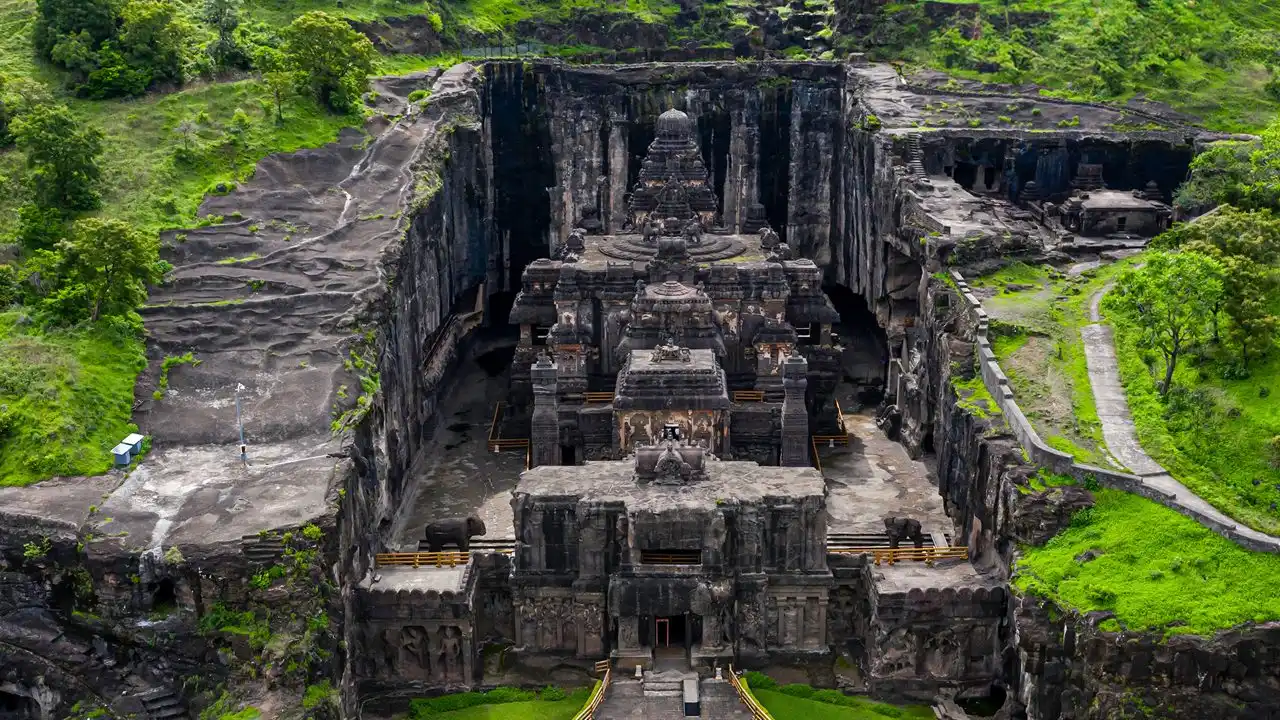
The Ellora Caves, about 30 kilometres and 45 minutes from the city, are a UNESCO World Heritage site of 34 rock-cut Buddhist, Hindu and Jain temples carved over centuries. The highlight is the Kailasa temple, the largest single monolithic rock excavation in the world, carved top-down from one piece of rock. Ellora is closed on Tuesdays, so plan accordingly.
Ellora is the closer and, for many, the more astonishing of the two cave sites, about 30 kilometres from the city, an easy 45-minute drive. It is a row of 34 caves cut into a basalt cliff between roughly the 6th and 10th centuries, and what makes it special is that it brings together three faiths in one place, Buddhist, Hindu and Jain temples side by side, a remarkable record of religious coexistence.
The centrepiece is Cave 16, the Kailasa temple, and it is hard to overstate it. The largest monolithic structure in the world, it was carved downwards out of a single rock, removing an estimated 200,000 tonnes of stone, to create a full multi-storeyed temple complete with halls, sculptures and a courtyard, all from one piece of the mountain. Standing in it is one of the great experiences in Indian travel. The crucial planning note is that Ellora is closed on Tuesdays, so never schedule it for that day. Go in the morning, allow three to four hours, wear good shoes, and carry water. For an early start to beat the heat and crowds, it helps to be based centrally at IRA Sambhajinagar.
A little guidance on seeing Ellora well. The caves are numbered, roughly Buddhist at one end, Hindu in the middle and Jain at the other, but you do not need to see all 34 to feel the place; the Kailasa temple, Cave 16, deserves the bulk of your time and attention, ideally with a guide to point out the carving you would otherwise walk past, the elephants supporting the base, the panels of the epics, the sheer logic of how it was excavated. The Buddhist Cave 10, a chaitya prayer hall with a stone arch, and the elaborate Jain caves at the far end are the other highlights. The site is spread out with some climbing and steps, so wear comfortable shoes and pace yourself, and remember the green monsoon months bring seasonal waterfalls tumbling near the caves, a lovely bonus if you visit then.
The Ajanta Caves, about 100 kilometres and 2.5 to 3 hours from the city, are a UNESCO World Heritage site of 30 Buddhist caves carved into a horseshoe cliff, famous for their ancient murals and sculptures dating from the 2nd century BCE. The paintings are among the finest surviving ancient art in the world. Ajanta is closed on Mondays, so plan the trip around it.
Ajanta is the older and more remote of the two, about 100 kilometres from the city and a drive of two and a half to three hours, so it is a full-day trip and worth every minute. The 30 caves, cut into a dramatic horseshoe-shaped cliff above a river gorge, were Buddhist monasteries and prayer halls, abandoned and forgotten for over a thousand years until a British hunting party stumbled on them in 1819, which is partly why their contents survived so well.
What you come for is the painting. The murals of Ajanta, depicting the life of the Buddha and the Jataka tales, are among the greatest surviving works of ancient art anywhere, their colour and expression astonishing for their age. The sculpture is superb too. The planning notes matter here: Ajanta is closed on Mondays, the site involves a fair amount of walking and steps, and you park and take a short shuttle bus to the caves themselves. Start early for the long drive, allow a full day, and carry water and sun protection. Doing Ajanta and Ellora on separate days, given the distance, is far better than trying to rush both.
A few specifics make the long Ajanta day go better. From the car park, you take a short government shuttle bus to the last stretch to the caves, and the famous viewpoint across the gorge, from where the British party first spotted the caves, is worth the short detour for the classic horseshoe view. Inside, the light is deliberately kept low to protect the fragile paintings, so give your eyes time to adjust and resist using flash, which is not allowed; a guide or a good guidebook hugely repays the effort here, because the murals reward knowing what you are looking at. Caves 1, 2, 16 and 17 hold the best-preserved paintings, and Cave 26 holds the finest sculpture, including a large reclining Buddha. Carry water, wear shoes for steps, and treat it as the centrepiece of its own unhurried day.

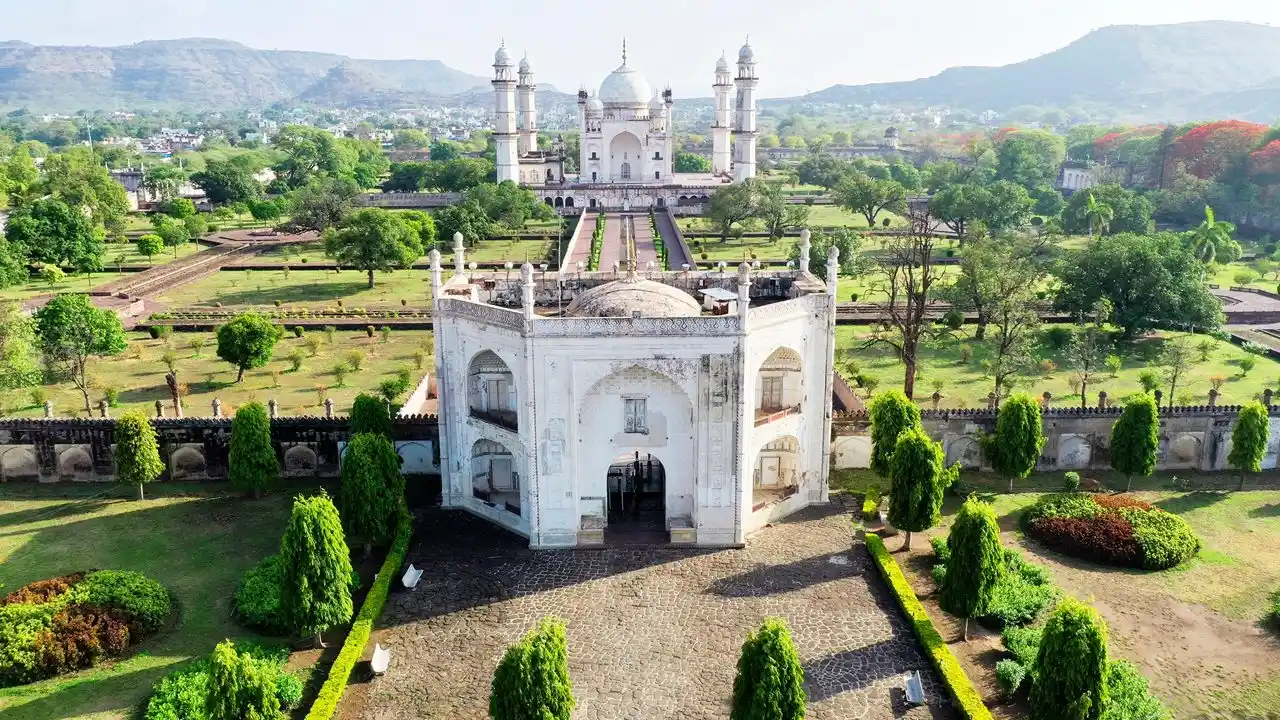
Bibi Ka Maqbara, about 5 kilometres from the city centre, is a 17th-century marble mausoleum built by the Mughal prince Azam Shah for his mother, closely modelled on the Taj Mahal, which earns it the nickname the Taj of the Deccan or the poor man's Taj. Set in formal gardens, it is the city's signature monument and an easy, rewarding in-city visit.
The city's own great monument is Bibi Ka Maqbara, a Mughal tomb built in the late 17th century by Aurangzeb's son Azam Shah in memory of his mother, Dilras Banu Begum. It is deliberately modelled on the Taj Mahal, with a central domed mausoleum, four minarets and formal Mughal gardens, which is why it is so often called the Taj of the Deccan. Built on a smaller budget than its inspiration, it uses marble on the lower sections and plaster above, but the silhouette is unmistakable and genuinely beautiful, especially in the soft morning and evening light.
It sits about 5 kilometres from the city centre, an easy trip, and an hour is enough to walk the gardens and the tomb. Go early or late for the light and the cooler air, and pair it with the nearby Aurangabad caves on the hill behind, which look down over the maqbara. For anyone who cannot make it to Agra, or who simply loves Mughal architecture, it is a lovely and far less crowded alternative, and a fitting symbol of the city's layered history.
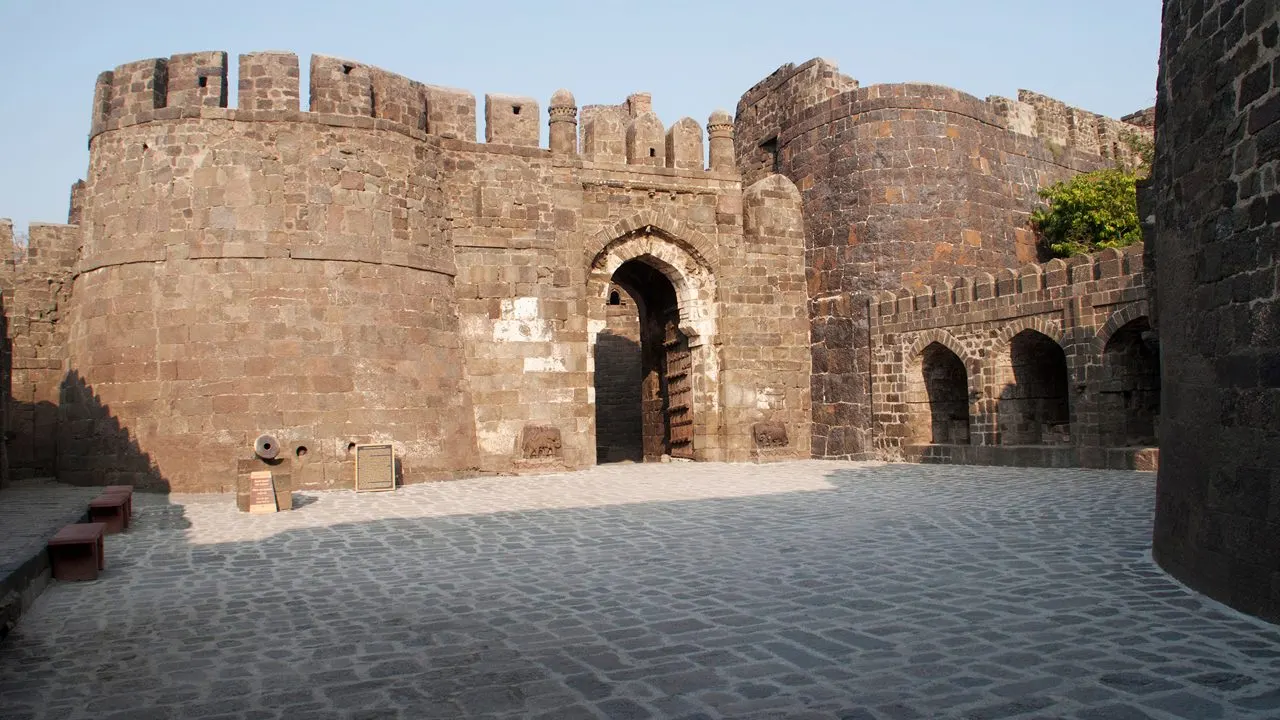
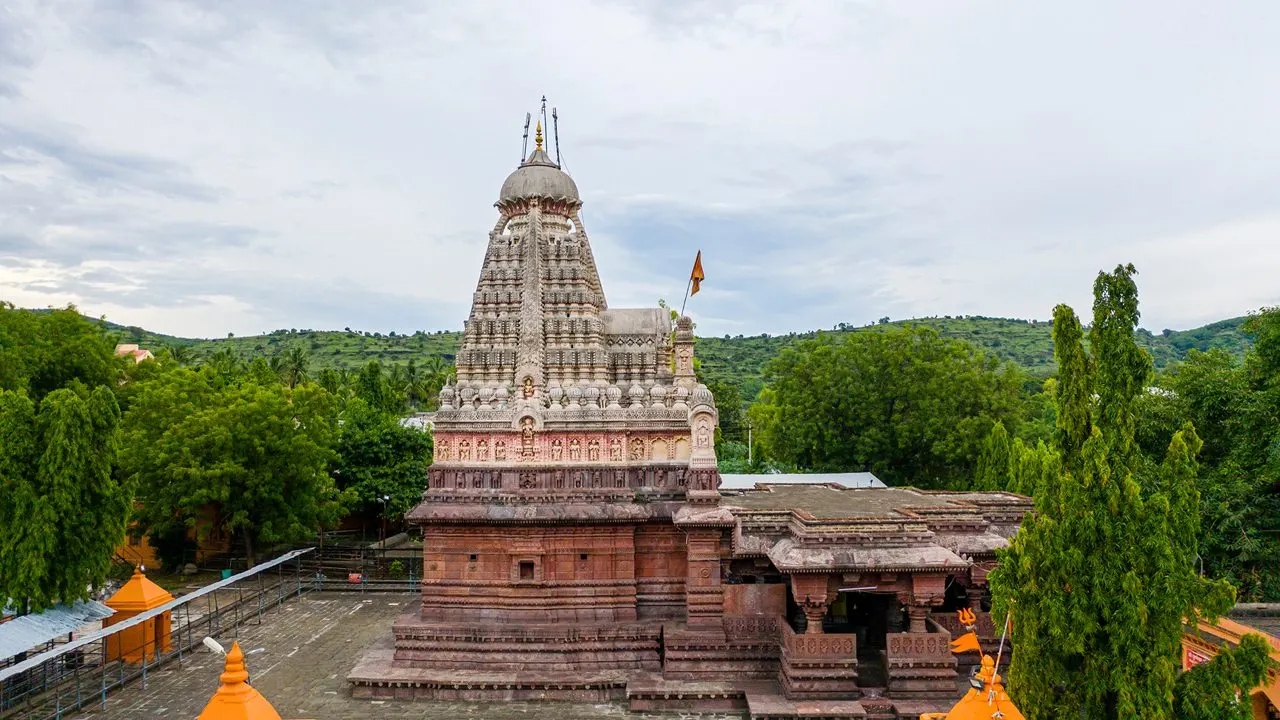
On the road to Ellora, about 15 kilometres from the city, the medieval Daulatabad Fort rises on a conical hill, one of the most formidable forts in India. Nearby, the Grishneshwar Temple is one of the twelve sacred Jyotirlingas of Shiva, and the town of Khuldabad holds the simple tomb of the emperor Aurangzeb. All combine naturally with an Ellora day.
The Ellora road is lined with history, which makes for an efficient day. Daulatabad Fort, about 15 kilometres from the city, is the standout, a 12th-century hill fortress on a steep conical rock, once briefly the capital of a sultan who tried to move all of Delhi here. Its defences are legendary: moats, a dark winding passage built to confuse invaders, and a long climb to the summit that rewards you with sweeping views, easily a couple of hours for the energetic.
Close to Ellora itself stands the Grishneshwar Temple, one of the twelve Jyotirlingas, the holiest shrines of Shiva in India, drawing pilgrims from across the country and well worth a respectful visit alongside the caves. The small town of Khuldabad nearby holds the surprisingly plain and modest tomb of the emperor Aurangzeb, who asked to be buried simply, a striking contrast to the grandeur he built. Because these all lie on or near the Ellora route, the smart plan is to combine the fort, the temple and the caves into one well-paced day out from the city.
In the city itself, the Aurangabad Caves, about 5 to 8 kilometres away, are a group of ancient Buddhist rock-cut caves on a hill behind Bibi Ka Maqbara. Panchakki is a 17th-century water mill and garden complex driven by an ingenious channel. The Soneri Mahal, the state museum and Salim Ali Lake round out an easy half-day of in-city sights.
Beyond the headline sights, the city itself has plenty for a half-day. The Aurangabad Caves, a set of Buddhist caves carved into the hillside north of the city behind Bibi Ka Maqbara, are far quieter than Ellora and Ajanta and have fine sculpture, with the bonus of views over the maqbara and the city, about 5 to 8 kilometres from the centre. Panchakki, meaning water mill, is a 17th-century complex where a clever underground channel from a spring drove a mill and fed a garden and fish pond, an elegant piece of old engineering beside the dargah of a Sufi saint.
The Soneri Mahal, a small palace now housing a museum, and the Chhatrapati Shivaji Maharaj Museum give more of the city's history, while the Salim Ali Lake and bird sanctuary, named after the famous ornithologist, offers a green pause. The city's old gates, it was once known as the city of gates for its many surviving Mughal-era darwazas, are dotted around and worth noticing as you move about. None of these needs long, and together they fill the time around the bigger cave trips nicely.

The signature dish of Chhatrapati Sambhajinagar is naan qalia, a rich mutton curry eaten with naan, a local speciality born of the city's Mughal and Deccan heritage. The cuisine leans on the flavours of nearby Hyderabad, with biryani and tahari, alongside Marathwada home cooking. The hotel's rooftop restaurant, Upper Deck, serves a multi-cuisine menu with views over the city.
The city's food reflects its history, sitting between the Mughal-influenced Deccan and the Marathwada countryside. The dish to seek out is naan qalia, the city's own speciality, a spiced mutton curry, the qalia, eaten with naan, traditionally tied to the city's old textile workers and now a point of local pride. The wider cuisine carries the rich, aromatic influence of nearby Hyderabad, so the biryani here is excellent, along with tahari and a range of kebabs and Mughlai dishes.
Alongside the meaty Deccan fare is the simpler vegetarian home cooking of the Marathwada region, and the usual Maharashtrian favourites are easy to find. For a relaxed meal with a view, our own rooftop restaurant, the Upper Deck, serves a multi-cuisine menu over the city skyline, good for dinner after a day at the caves. The honest advice is to make a point of eating the local naan qalia and a proper Deccan biryani at least once, because that taste of the old Aurangabad is as much a part of the city as its monuments.
A few more notes for the food-minded. The naan qalia here has a real local story, said to have been the affordable, filling meal of the city's old weaving community, the qalia made from offcuts of meat slow-cooked with spices and eaten with the soft local naan, and the better old-city eateries still do it proud. Beyond it, look for the Mughlai kebabs and the rich biryani that the Deccan does so well, and, for the sweet tooth, the milky, syrupy desserts common to the region. Vegetarians are well looked after with Marathwada and wider Maharashtrian cooking. The simplest advice is to eat at least one meal in the older part of the city for the authentic Deccan flavour, and to use the hotel's Upper Deck for a relaxed dinner with a view after a long day at the caves.
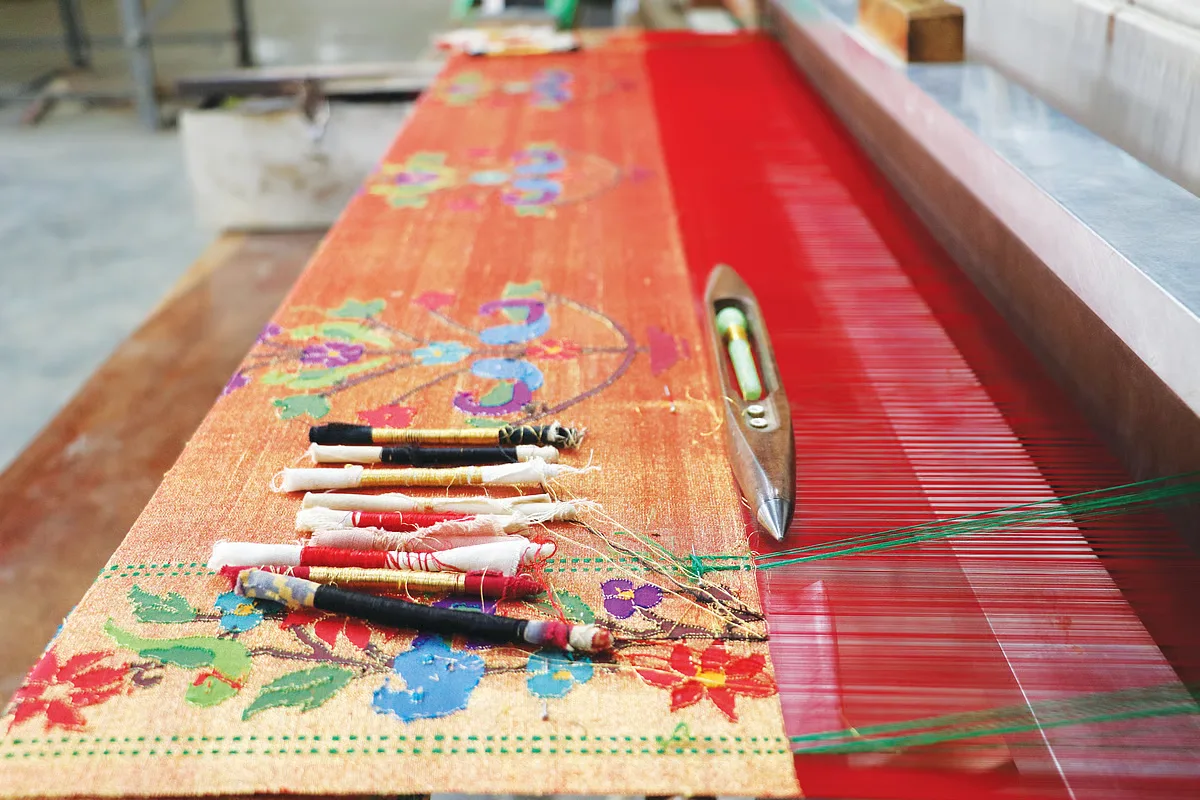
Chhatrapati Sambhajinagar is famous for textiles: the Paithani silk saree, woven with gold zari in the nearby town of Paithan, prized as one of India's finest sarees, and the Himroo shawl, a traditional brocade weave unique to the city. Bidri metalwork and local handlooms round out the shopping, best bought from the city's weaving workshops and emporiums.
This is one of India's great textile cities, and the crafts are the souvenirs to bring home. The Paithani saree is the star, a luxurious silk saree woven with intricate gold and silver zari and distinctive peacock and lotus motifs, made in the nearby town of Paithan and counted among the most prestigious sarees in the country, an heirloom rather than an impulse buy. You can watch the painstaking weaving at workshops in the city and at Paithan itself.
The city's other signature is Himroo, a traditional brocade-like fabric of silk and cotton woven with Persian-influenced patterns, once made for royalty and now kept alive by a few weaving centres where you can see the looms and buy shawls and stoles. The region is also known for Bidri metalwork and local handlooms. For genuine pieces, buy from the established weaving workshops and government emporiums rather than tourist stalls, and treat a Paithani or a Himroo as the real, lasting memento of a trip here.

The best time to visit Chhatrapati Sambhajinagar is October to March, the cool, dry, pleasant season, ideal for the caves and outdoor sights. The monsoon, from July to September, turns the Ellora area green and the waterfalls flow. Summer, April to June, is very hot in this part of Maharashtra, so sightseeing is best kept to early mornings with afternoon breaks indoors.
This is inland Maharashtra, where the seasons run to extremes, so timing matters.
Winter, October to March, is comfortably the best time. The weather is cool and dry, perfect for the long days of walking the caves, the fort and the monuments, and for the day trips out to Ajanta and Ellora. This is the peak tourist season for good reason, and the easiest time to enjoy the outdoor sights.
The monsoon, July to September, brings a green transformation to the Ellora hills and the surrounding country, with seasonal waterfalls near the caves, a beautiful if wetter time to visit. Summer, April to June, is the season to be wary of, as the Marathwada region gets genuinely hot, often well above 40 degrees, so keep cave visits to the early morning, rest in the afternoon, and use the hotel pool in the heat. If your dates are flexible, aim for the winter; whatever the season, the cave closing days, Ajanta on Mondays and Ellora on Tuesdays, matter far more than the weather to your planning.
Chhatrapati Sambhajinagar has its own airport, about 10 kilometres from the city, with flights from the major Indian cities, and a railway station on the central network. By road, it is about 330 kilometres from Mumbai and 230 kilometres from Pune. The hotel on the Beed Bypass Road is central and well-connected. A hired car is the best way to reach the caves and forts.
The city is well-connected for a heritage destination. Chhatrapati Sambhajinagar Airport, still widely called Aurangabad Airport, is about 10 kilometres east of the city and has direct flights from Mumbai, Delhi, Hyderabad and other cities, the quickest way in. The railway station is central and on the network from Mumbai, Pune and beyond, and the overnight trains from Mumbai are a popular option. By road, it is roughly 330 kilometres from Mumbai and 230 kilometres from Pune, a long but manageable drive, with buses and taxis running the routes.
Once here, the sights are spread out, so a hired car with a driver for the day is by far the best way to do the caves, the fort and the temple, letting you start early and move at your own pace; app cabs and autorickshaws cover the in-city sights. The Beed Bypass location of the hotel keeps the airport, the station and the routes out to Ellora and Ajanta all within easy reach. The honest planning summary is to fly or take the train in, hire a car for the cave days, and base yourself centrally so the early starts are easy. To stay near it all, you can book your central Sambhajinagar stay at IRA.
For two to three days, spend one day at Ellora with Daulatabad Fort and Grishneshwar on the way, one full day at Ajanta given the distance, and a half-day in the city for Bibi Ka Maqbara, the Aurangabad caves and Panchakki, plus shopping for Paithani and Himroo. Schedule around the closing days: not Ellora on a Tuesday, not Ajanta on a Monday.
The classic Aurangabad circuit fits neatly into two or three days, as long as you plan around the closing days. A strong shape: day one, Ellora, combined with Daulatabad Fort and the Grishneshwar temple on the same road, a full and rewarding day of carving, climbing and history; day two, Ajanta, given its own full day because of the long drive and the walking involved; and a half-day, either side, for the city, Bibi Ka Maqbara in the soft morning light, the Aurangabad caves on the hill behind, and Panchakki, with time left for textile shopping.
The non-negotiable planning rule is the closing days: Ellora is shut on Tuesdays and Ajanta on Mondays, so build your days around those, never both caves on the same day, given the distance, and always an early start to beat the heat and the tour groups. In three days, you can add Paithan for the sarees and the Jayakwadi dam, or simply take the city more slowly. It is one of India's most rewarding heritage circuits, and a central base makes it run smoothly, so you can book your heritage-trip base at IRA Sambhajinagar.
If you have only a single day, be realistic and choose one cave site rather than attempting both; Ellora, being far closer and home to the Kailasa temple, is the better one-day choice, and it pairs with Daulatabad Fort on the same road. In two days, you will get both caves properly. With three or more, you can slow the whole thing down, add Paithan for the sarees and the Jayakwadi reservoir, spend longer in the old city, or simply rest between the big days. Whatever the length, the two rules that never change are to plan around the closing days and to start early, because the combination of heat, walking and crowds later in the day is the main thing that tires people out. Get those right, and the circuit is a joy rather than a slog.
Chhatrapati Sambhajinagar is a major industrial centre, with auto, pharmaceutical and engineering plants in the Shendra, Waluj and Chikalthana zones and the AURIC smart industrial city. For business travellers, the hotel's central Beed Bypass location, close to the airport and the industrial areas, with fast Wi-Fi, workspaces and meeting and banquet facilities, makes it a practical corporate base.
The city is not only about heritage; it is one of Marathwada's main industrial and commercial hubs, and a steady share of visitors come for work. The MIDC industrial areas at Shendra, Waluj and Chikalthana host auto, auto-component, pharmaceutical, brewing and engineering companies, and the newer AURIC, the Aurangabad Industrial City, is a large planned smart-industrial township drawing fresh investment. This keeps the city's hotels busy with corporate and engineering travel through the week.
For a work trip, the hotel's central position on the Beed Bypass Road is an advantage, with the airport close, the industrial zones reachable, and the city sights on hand for any spare time. A business stay needs reliability, fast Wi-Fi, proper workspaces, meeting and conference space and good dining at the right hours, all of which the hotel covers, with the banquet and event facilities for corporate functions and the Upper Deck rooftop for dinners. For a productive, well-located corporate stay, you can book a business stay at IRA Sambhajinagar.
For families, the caves, the fort climb at Daulatabad, the Salim Ali Lake and the hotel pool make an engaging, history-rich trip. For couples, the romance of Bibi Ka Maqbara at golden hour, the wonder of the caves, the rooftop dining and the textile shopping make a cultured, unhurried break away from the usual crowds.
The city suits both families and couples in different ways. Families find plenty to hold children's interest: the scale and adventure of the caves and the Daulatabad fort climb, the bird life at Salim Ali Lake, and the pool back at the hotel for downtime. The key with younger children is to pace the cave days, which involve walking and heat, with breaks and an early start, and to balance them with the easier in-city sights.
For couples, the appeal is a different kind of trip, cultured and calm rather than the usual getaway. Bibi Ka Maqbara is genuinely romantic in the soft light of early morning or sunset, the caves are awe-inspiring to share, the rooftop dinners at the Upper Deck are relaxed, and the textile shopping for a Paithani makes a memorable thing to choose together. For travellers who like their breaks rich in history and light on crowds, the city is a quietly rewarding choice for two.
IRA by Orchid Chhatrapati Sambhajinagar offers banquet and wedding halls for weddings, receptions, corporate meetings and social events, with full-service support, multi-cuisine catering, the Upper Deck rooftop and rooms for guests on site. Its central location near the airport and the city makes it convenient for families and delegates arriving from across the region.
For events, the hotel is well set up. The banquet halls in Sambjajinagar Aurangabad suit the full range, from weddings, engagements and receptions to corporate meetings, conferences and social gatherings, with the decor, amenities and dedicated support a smooth event needs. For a city wedding, the combination of an event space, catering and rooms for out-of-town guests in one place takes much of the stress out of the planning.
The practical advantages are the location and the package. Being central and close to the airport, the hotel is easy for families and delegates arriving from Mumbai, Pune, Hyderabad and beyond, and the event team handles the planning end to end, with catering, the rooftop for cocktails or smaller functions, and accommodation for guests. For a wedding, conference or corporate event in the city, you can enquire about events and rooms at IRA Sambhajinagar.
The city's culture is a blend of Mughal, Deccan and Maratha heritage. Mahashivratri draws crowds to the Grishneshwar Jyotirlinga, the region celebrates the major Maharashtrian festivals like Ganesh Chaturthi and Diwali, and the living crafts of Paithani and Himroo weaving are a culture in themselves. Cultural events are sometimes held against the backdrop of the Ellora caves.
The character of Chhatrapati Sambhajinagar comes from its layered past, a Mughal Deccan capital set in a Maratha land, with ancient Buddhist, Hindu and Jain roots in the surrounding caves. That mix shows in its festivals and daily life. The biggest religious draw is Mahashivratri, when the Grishneshwar Jyotirlinga, one of the holiest Shiva shrines in India, fills with pilgrims, a powerful time to witness the temple, though a crowded one to visit. The city and region also celebrate the great Maharashtrian festivals with energy, Ganesh Chaturthi, Navratri, Dussehra and Diwali among them.
The deeper culture, though, is in the crafts and the monuments. The Paithani and Himroo weaving traditions are living heritage, passed down through generations and kept alive in the city's workshops, and watching a weaver at work is a cultural experience in its own right. Classical music and dance performances are sometimes staged with the Ellora caves as a backdrop, a memorable pairing of art and setting. Even outside any festival, the everyday rhythm of the old city, its gates, its dargahs, its bazaars and its food, carries a sense of history that rewards a curious traveller. Timing a visit to a festival is a bonus rather than a necessity, since the monuments are the year-round draw.
Staying centrally on the Beed Bypass Road puts you close to the airport, the railway, the city sights and the roads to Ellora and Ajanta. IRA by Orchid is an eco-conscious hotel here with Deluxe, Premier and Suite rooms, the Upper Deck rooftop restaurant, a pool, a spa and fitness centre, and banquet and wedding halls, part of the Orchid Hotels group.
For a trip built around the Ajanta and Ellora circuit, a central, well-connected base is the smart choice, and that is where the hotel sits, on the Beed Bypass Road within easy reach of the airport, the station, the in-city monuments and the highways out to the caves. IRA by Orchid is part of the Orchid Hotels family, carrying the group's eco-conscious approach and its reputation for warm, reliable service.
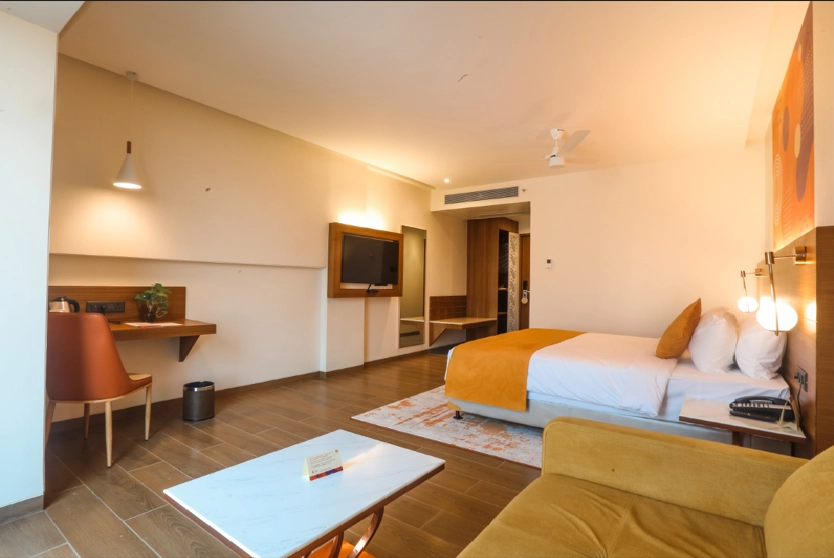
The rooms come in three categories to suit different travellers: the comfortable Deluxe at 264 square feet, the more spacious Premier at 320 square feet, and the Suite at a generous 442 square feet for those wanting more room or a special stay, all with modern interiors, high-speed Wi-Fi and ergonomic workspaces. Beyond the rooms, there is the Upper Deck rooftop restaurant with its city views, a swimming pool, a spa and fitness centre, a lounge, and banquet and wedding halls, with the group's eco-conscious touches throughout. You can see the IRA Sambhajinagar room types, check live rates and book your central stay directly for the best rate.
A quick word on choosing a room for your trip. For a short heritage trip or a solo business stay, the Deluxe is the sensible, comfortable pick, with the desk and Wi-Fi a working traveller needs. The Premier steps up the space for a longer stay, a couple or a guest who wants more room to spread out after long days at the caves. The Suite, the most generous at 442 square feet, suits families, a special occasion, or anyone who simply wants the most comfortable base for the trip. Because the cave days are long and tiring, a comfortable room to return to matters more here than on a city break, so it is worth matching the category to how hard you plan to sightsee rather than defaulting to the smallest option.

Chhatrapati Sambhajinagar is an affordable heritage destination. Hotel rates vary by room category and season, with the cool October to March peak busiest and dearest. Beyond the room, the main costs are a hired car for the cave days, the modest monument entry fees, and any Paithani or Himroo shopping. Booking direct adds the Orchid Rewards discount.
This is one of the better-value heritage trips in India, with the city offering a lot of history for a modest spend. Hotel rates move with the room category, from the Deluxe through the Premier to the Suite, and with the season, the pleasant winter being the busiest and priciest stretch and the hot summer the quietest and cheapest. Being a strong business destination, weekdays can be busier than weekends with corporate travel.
Beyond the room, the spend is modest and predictable: a hired car with driver for the Ellora and Ajanta days is the main cost, the monument and cave entry fees are inexpensive, and meals, especially the local food, are very affordable. The one place worth spending more is on a genuine Paithani or Himroo if you want a keepsake. The reliable way to keep the cost sensible is to book direct for the Orchid Rewards discount and any package, and to come in the winter if you can, accepting that it is the busy season. For the depth of heritage on offer, the city is excellent value.
IRA by Orchid Chhatrapati Sambhajinagar offers an Orchid Rewards discount of up to 30 percent on direct bookings, along with member benefits, corporate rates and packages for families and event guests. Booking direct on the hotel's own page is the best value and the surest way to get the current Orchid Rewards rate and any live package.
The value advice is the same across the group: book direct. The Orchid Rewards programme gives up to 30 percent off on direct bookings, plus member benefits and points, and the hotel adds corporate rates and packages for families and event guests, all best accessed directly rather than through a travel site that takes a commission. For the busy winter heritage season, book ahead. To get the live discount and current packages, check the latest IRA Sambhajinagar offers and book directly.
For deeper planning, read our focused guides: Ellora Caves Guide, Ajanta Caves Guide, Bibi Ka Maqbara and City Sights, Aurangabad Food Guide, Paithani and Himroo Shopping, Ajanta and Ellora Itinerary.
What are the top things to do in Chhatrapati
Sambhajinagar?
The top things to do are the Ellora caves with the Kailasa temple, the
Ajanta caves with their ancient paintings, Bibi Ka Maqbara, Daulatabad Fort,
the Grishneshwar Jyotirlinga temple, the Aurangabad caves and Panchakki in
the city, and shopping for Paithani sarees and Himroo. Plan around the cave
closing days.
Is Chhatrapati Sambhajinagar the same as Aurangabad?
Yes. The city was officially renamed Chhatrapati Sambhajinagar in 2023,
after the Maratha king Sambhaji, but it is still widely known and searched
as Aurangabad, and many of its monuments, such as the Aurangabad caves, keep
the older name.
Which days are the Ajanta and Ellora caves closed?
The Ajanta caves are closed on Mondays, and the Ellora caves are closed on
Tuesdays. This is the most important thing to plan around, so never schedule
Ajanta for a Monday or Ellora for a Tuesday, and never try to do both in one
day, given the distance between them.
How far are Ellora and Ajanta from the city?
The Ellora caves are about 30 kilometres, a 45-minute drive, and the Ajanta
caves are about 100 kilometres, two and a half to three hours away. Ellora
is usually combined with Daulatabad Fort and Grishneshwar on the same day,
while Ajanta is given its own full day.
What is Bibi Ka Maqbara?
Bibi Ka Maqbara is a 17th-century Mughal marble mausoleum about 5 kilometres
from the city centre, built by Aurangzeb's son for his mother and modelled
on the Taj Mahal, which earns it the nickname the Taj of the Deccan. Set in
formal gardens, it is the city's signature monument.
What food is Chhatrapati Sambhajinagar famous for?
The signature dish is naan qalia, a rich spiced mutton curry eaten with
naan. The cuisine carries the Mughal and Hyderabadi influence of the Deccan,
so the biryani and kebabs are excellent, alongside Marathwada home cooking.
The hotel's Upper Deck rooftop serves a multi-cuisine menu.
What should I shop for in Chhatrapati Sambhajinagar?
The city is famous for textiles: the Paithani silk saree, woven with gold
zari in nearby Paithan, one of India's finest sarees, and the Himroo brocade
shawl, unique to the city. Bidri metalwork and local handlooms are also good
buys, best bought from established weaving workshops and emporiums.
When is the best time to visit?
October to March is best, with cool, dry, pleasant weather for the caves and
outdoor sights. The monsoon, from July to September, turns the Ellora area
green. Summer, April to June, is very hot in this part of Maharashtra, so
keep sightseeing to early mornings and use the pool in the afternoon.
How many days do you need?
Two to three days is ideal: one for Ellora with Daulatabad Fort and
Grishneshwar, one full day for Ajanta, and a half-day for the city's Bibi Ka
Maqbara, the Aurangabad caves and Panchakki, plus textile shopping. Always
plan around the closing days, Ajanta on Mondays and Ellora on Tuesdays.
Is the city good for business travellers?
Yes. It is a major industrial hub, with auto, pharmaceutical and engineering
plants at Shendra, Waluj and Chikalthana and the AURIC smart-industrial
city. IRA by Orchid's central Beed Bypass location near the airport, with
fast Wi-Fi, workspaces and meeting facilities, makes it a practical
corporate base.
What rooms does IRA Sambhajinagar have?
IRA by Orchid Chhatrapati Sambhajinagar has three room categories: the
comfortable Deluxe at 264 square feet, the more spacious Premier at 320
square feet, and the Suite at a generous 442 square feet, all with modern
interiors, high-speed Wi-Fi and ergonomic workspaces.
How do I reach Chhatrapati Sambhajinagar?
The city has its own airport about 10 kilometres away, with flights from
Mumbai, Delhi, Hyderabad and other cities, and a central railway station on
the network from Mumbai and Pune. By road, it is about 330 kilometres from
Mumbai and 230 kilometres from Pune.
Is Grishneshwar one of the twelve Jyotirlingas?
Yes. The Grishneshwar Temple, near the Ellora caves about 30 kilometres from
the city, is one of the twelve sacred Jyotirlinga shrines of Shiva in India,
drawing pilgrims from across the country. It combines naturally with an
Ellora day trip.
Plan around the closing days, give Ellora and Ajanta a day each, fit the city and the shopping around them, and base yourself centrally so the early starts are easy. Do that and this is one of India's most rewarding heritage trips. When you are ready, book your stay at IRA by Orchid Chhatrapati Sambhajinagar.
Beed Bypass Rd,
PWD Colony, Aurangabad,
Maharashtra 431005
Email: reservations@orchidhotel.com
Call: +91 8652 636363